Showing posts with label Potatoes. Show all posts

Saturday, 3 November 2012

Potato, Onion & Anchovy Bake


Last month John Lewis asked me to submit a recipe for their Delicious Magazine Hotpoint fridge competition which is now live; the brief was to create something that can be made with all the odds and ends you find in your fridge. With Vegan Month swiftly approaching, I made hasty use of the leftover anchovies swimming about in oil and the tub of cream that was near its souring date. A comforting bake of thinly sliced potatoes, softened onions and cream was perfect for the Autumnal weather; a sprinkling of dill throughout each layer gave it some fragrance. 


It's fairly important to keep the slices of the potato thin, so that you get a nice layering effect. The anchovies dissolve into the cream to add a savoury yet not fishy tinge, and the softened onions some sweetness.


Serve this as the main dish - it's too tasty to be a side - with a tangle of salad leaves dressed in a mustardy dressing. You need something sharp to cut through the creaminess of the bake. If you haven't got dill to hand, chopped parsley or sprigs of thyme might work nicely too. I shall spend November revelling in the memory of how deliciously, waist-expandingly rich this was.


Potato, Onion & Anchovy Bake


Serves 4


4 medium floury potatos
2 white onions
12 anchovy fillets in oil
A handful of fresh dill
300ml double cream
100ml milk
2tbsp vegetable oil
1 tsp sherry vinegar
1 tsp sugar
50gr butter
Salt & pepper


Preheat the oven to 200 degrees C. Slice the onions into half moon shapes and slowly fry in the oil with the sugar and vinegar in a non-stick pan. Meanwhile, slice the potatoes thinly, to the thickness of a 10p piece - a mandolin does this easiest, or a steady hand and a sharp knife.


Heat the milk and cream on the stove. Layer a casserole or pie dish with a layer of potato slices - some of them can overlap. Season generously with pepper and lay 3 anchovies evenly across the potatoes. Scatter with dill and place a quarter of the onions on top. Cover with some of the cream mixture and top with more potato slices and the rest of the onions and anchovies and the cream to create four or so layers in total, pressing them down as you go. The top layer should be potato slices. Dot with butter and place in the oven. 


Bake for an hour, remove from the oven and leave to rest for 10 minutes. Serve with a green salad.


To browse John Lewis' range of cookware and fridges, visit their website.
In case it wasn't obvious, I was paid a fee for this recipe.

Wednesday, 29 August 2012

Dak Doritang - Korean Chicken Stew


I was after something simple and homely, something I could stick on the stove so that I could flop on the couch and gaze inanely at the TV. I wanted something vivid with a variety of textures and I wanted something meaty. I knew I was being picky but a quick Google search told me that Korean was the way to go. 

Usually a winter dish, Dak Doritang (spicy simmered chicken stew) has many variations and recipes, but all I found include chicken and potatoes. And then served over rice. Double carbing! I was sold.


This recipe is an amalgamation of lots I found over the internet, and having never been to Korea or tried this dish in a Korean restaurant, I have no idea whether it is 'authentic' or not. It is delicious though, and given how simple it was to put together and the short ingredients list, it is set to be a staple. The sweetness of the sauce tempers the heat of the chilli, making it tongue-tingling but not excruciating. Well, not for me anyway; my housemate broke a sweat so if you're not very tolerant perhaps dial down the chilli powder a bit. It's not the most attractive of dishes - stews, I find rarely are - but more a giant bowl to bury your face in. 


I used dark chicken meat on the bone which I think is very important; given that you're using a water base rather than stock you need to get maximum flavour given the relatively short simmering time, and the bones help do this. Also, it's more fun eating meat off the bone. I kept the skin on the chicken, adding more flavour and texture and I understand that flabby chicken skin isn't high on everyone's favourites list, but personally I love it. Remove it if it gives you the wibbles.


Dak Doritang


Serves 4


For the sauce: 2 tbsp Gochujang (get this at your local Asian supermarket)
3 tbsp coarse Korean chilli powder (this stuff is not blow-your-face-off but gives it the red colour so if you use a different chilli powder be careful with quantities)
5 cloves of garlic, minced
2" piece of ginger, minced
3 tbsp light soy sauce
1 tbsp white sugar
1 tbsp rice wine (Shaoxing)
2 tbsp ketchup (yes really)
60ml water


4 large chicken thighs - get your butcher to chop each into 4 for you, or get your cleaver out.
2 medium white onions, chopped into 6
2 carrots, chopped roughly
6 new potatoes, sliced in half (so they're bite-sized)
A handful of green beans - any greenery you have, really
4 spring onions, sliced diagonally 


Bring a pan of water to the boil and drop the chicken pieces in. Simmer for two minutes, drain and rinse the pan and the chicken thoroughly. 


Meanwhile, combine the sauce ingredients and add the chicken, tossing well. Place back in the pan and bring to the simmer. Add the potatoes and the onions and simmer for 10 minutes with the lid on, then add the onions and simmer for another 20 mins lid on, tossing all the ingredients in the sauce well. If it's looking a little dry, add more water but this is supposed to be nice and thick. Remove the lid, stir and add the greenery and simmer for another 15 minutes, gently. Serve over steamed white rice with the sliced spring onions garnishing each dish. 

Thursday, 1 March 2012

A Weekend in Amsterdam

Eurostar were kind enough to send me and a friend off on a jolly to Amsterdam for a weekend. Imagine my surprise when we turned up at Citizen M to find the shower open plan to the bed (which we already knew we were sharing...). But we were there for one thing and one thing only - to do some eating.


We headed to Albert Cuypstraat to Albina for some Surinamese food. Suriname had been a former colony of the Dutch Guiana (thanks Wikipedia) and subsequently Amsterdam has a high population of Dutch Surinamese. Fried potatoes turned up first, topped with fish floss which we drenched with caramel soy sauce and a spicy picalilli that was on the table.

Roasted chicken and char siu pork arrived in 'moki meksi' sauce with white rice; this is seemingly the roasting juices of the meat with some soy. Star of the show was the chicken curry - chunks of chicken served on the bone in a light curry sauce with potatoes, an egg and topped with a flaky and piping hot roti. We dug in with gusto. For 10 Euro each with a beer, Albina was a bit of a gem. I know nothing about Surinamese food but even though it was half way around the world from it, it reminded me a lot of Malaysian food.

The next day we took to the streets in search of some interesting food. Raw herring had been recommended to me and are are apparently quite plentiful, mostly on street corners in solid stands, displaying their wares behind a glass case. We sampled two, the best coming from Frens Heringshandel, off the flower market in Koningsplein - unfortunately the picture above is of the inferior version. Still, at around 3 Euro each the soft white bun is split and stuffed with the herring - raw? Cured? - and then topped with diced white onion and sliced pickles. I won't lie; this does make you honk of fishy onions, but it was delicious. The herring flesh is really soft and yielding, while the sharpness of the onions and pickles lifts the richness.

A recommendation from @ediblethings took us down to Voetboogstraat to Vleminckx Sausmeesters, a hole-in-the-wall chip shop. The queue was at least 10 strong (I'll admit, they were rather bleary / glazed of the eyes...) and when we got our chips I found out why. They were amazing. Crunchy on the outside, soft on the inside and well seasoned, we had ours topped with mayonnaise and diced onion. We were going for an oniony day.

We couldn't resist trying the Febo automats. A vending machine dispensing deep fried snacks and burgers? Yes please. We played it safe and went for a veggie cheese and mushroom croquette and it came out piping hot, crunchy on the outside and soft and yielding from the inside. It was filthily addictive.

After a cycle round the city screeching with terror - look, those trams are silent deathtraps - we turned up at the train station two hours late having misread the ticket. My friend and I realised at exactly the same point, and the sight of her horrified face remains etched deeply into my memory. Eurostar switched our seats with ease and thankfully we made it back to London on the last train back.

Eurostar go to Amsterdam from £99 return. It does take 5 hours though.

Friday, 20 May 2011

Pitt Cue Co. - Southbank

London can be pretty stunning sometimes, and one of my favourite views is from the Hungerford Bridge. What makes it even more of a favourite is that for the next four months, Pitt Cue Co. is a food truck parked up underneath said bridge.

Styled on barbeques that the Americans are so famous for, we hot-footed it down there the first day they were open (well, it IS on the way home after all). Cardboard boxes (at £7 each) full of porky delights made their way to us. Tender, pulled pork came with what initially was some chewy bread. A good soaking in the sauces made us realise what it was for; a big flavour sponge. Sweet smoky beans nestled in the box along with some crunchy, fresh coleslaw.

Gloucester Old Spot ribs were tender and juicy, with hardly any bone. Again with beans, the sweetness of the beans was off-set perfectly with some tangy fennel-scented pickles. Barbeque sauce on the side was enriched with tiny cubes of pork lardons and was sweet, smoky, and had a hint of spice.

A ridiculously decadent box of potatoes turned up. Wedges of Jersey royals lay under rotisserie chickens, slowly roasting in their fat and juices. Sticky and caramelised, these were outrageously good.

All washed down with a medium dry Burrow Hill cider, dusk turned to dark and we waddled our way home. An worthy addition to the chain-laden Southbank, I'll be returning; I am very excited about smoked corn on the cob. And they do Negronis.

Pitt Cue Co.

Under Hungerford Bridge, 7 days a week, around lunchtime till 10pm-ish.

Wednesday, 11 May 2011

Pickled Herrings

Once I get an idea in my head, that's it; I can't think of much else. I recently had a conversation with someone about Ikea and the foodstuffs you can purchase there and one thought of those little chunks of herring pickled in those jars, be it in sweet mustard or just dill, got the craving going. I wasn't about to attempt a trip to the Croydon warehouse of hellishness, so I set about making them myself.

I started off with Hugh Fernley-Whittingstall's recipe and went from there. Two different fish counters were scoured before I found the herrings that I needed, and for some unknown reason I even had a little cry when I gutted a pregnant herring, full of roe. Emotional stuff. The herrings were messily filleted - my knife 'skills' need work - and they sat in brine for a couple of hours while the pickling solution was cooling.

Pickled Herring

6 herrings
60gr salt

Gut and fillet the herrings - don't worry too much about bones as they are very fine and will soften when pickled. Dissolve the salt in 500ml water and place the fillets in it to brine for a couple of hours.

Pickle solution:

6 juniper berries
1 tsp mustard seeds
4 bay leaves
12 black peppercorns
600ml cider vinegar
6 tbsp light brown sugar
1 small onion, sliced very thinly
A handful of dill

Place all of it except the dill in a small sauce pan and bring to the boil. Simmer for 5 minutes and then leave to cool. Roll the fillets up and pack into a sterilised 1 litre jar or container. Rip the dill roughly and add it in. Pour the solution over your fillets and seal, storing in the fridge.


Hugh's recipe recommends you leave them for at least 5 days, but you can leave them up to a month. I left mine for 6 days before I tucked in. You may notice in the photo that there are strips of orange rind in the pickle solution too; I didn't find this very successful, it was too... orangey. So I'd leave them out. Otherwise, they were delicious. Slightly sweet, properly pickled and firm of flesh. They went beautifully with this summer salad.

Pickled Herring & Potato Salad

Serves 2

5 or 6 large new potatoes
A large handful of broad beans
150gr asparagus spears
7 or 8 cherry tomatoes, halved
Half a red onion
2 pickled herring fillets

Dressing:

4 tbsp extra virgin olive oil
1 tbsp red wine vinegar
1 clove of garlic, minced
1 tsp Dijon mustard
1 tsp sugar
2 tbsp dill, finely chopped
Salt & pepper to taste

Whisk the dressing ingredients together well. Meanwhile, set the potatoes on to cook in boiling salted water. I used frozen broad beans so I blanched them and then peeled them of their tough skins. Cook the asparagus until al dente. Toss the broad beans into the dressing and when the potatoes are cooked, halve them and add to the dressing while hot so that they soak it up.

To serve, scatter the asparagus on a plate and top with the broad bean and potato mixture. Halve the tomatoes and add on top with thinly sliced red onion. Finally, slice each herring fillet into 3 large chunks and place carefully on top.

Tuesday, 14 December 2010

Beetroot & Potato Rosti

Beetroot is a funny little thing. It's a violent vegetable, one that stains your skin, nails and clothes a deep, rich pink. In grating it, be it for salads or this rosti recipe, I invariably manage to leave a spray of juice behind; when dried, it looks like I've killed someone. But it has a earthy quality, one that's well paired with Scandinavian flavours of smoky fish and aniseedy dill.

Forman and Field sent me some of their smoked salmon, and their London cure worked brilliantly with the rosti. Supermarket smoked salmon can be aggressively salted and oily; this was melt in the mouth and delicate. I imagine this would make a lovely little starter. I just ate enough for 2 as my dinner.

Beetroot & Potato Rosti

Serve 2

4 large Vivaldi potatoes
2 beetroot
1 small onion
A hefty pinch of salt
Loads of black pepper
1 egg

I didn't bother to peel the potatoes, but do peel the beetroot. Grate into a bowl and then season. Gather in about 4 sheets of kitchen towel and squeeze all the moisture out - squeeze like hell so that your hands turn nice and red.

Whisk an egg in a bowl and add the potato and beetroot. Add the onion, sliced finely and the black pepper. Heat some oil in a non-stick pan and add the mixture to the pan, shaping it into a circle. Fry on a low heat, for about 15 minutes. Slide out onto a plate, then flip it back in, uncooked side down for a further 15 minutes until cooked through and crispy.

Serve with rocket dressed in a dill, yoghurt and lemon rind dressing with curls of smoked salmon.

Sunday, 12 December 2010

Gnocchi in Walnut Sauce

Recently I had a meal at Bella Vista in Blackheath and part of the set menu was a gnocchi dish with a creamy sauce. It was so delicious I asked a waiter what was in it; he came back from the kitchen with a scrap of paper, ingredients listed.

I've never made gnocchi before but have always been a fan. My first memorable experience was of eating it bathed in a four cheese sauce in a deserted Italian restaurant in Macau. I returned the evening after and ordered the exact same thing. So often they have a tendency to be a complete stodgefest, but home-made ones are different. These were delicate as a cloud, soft and sat deceptively lightly in the belly.

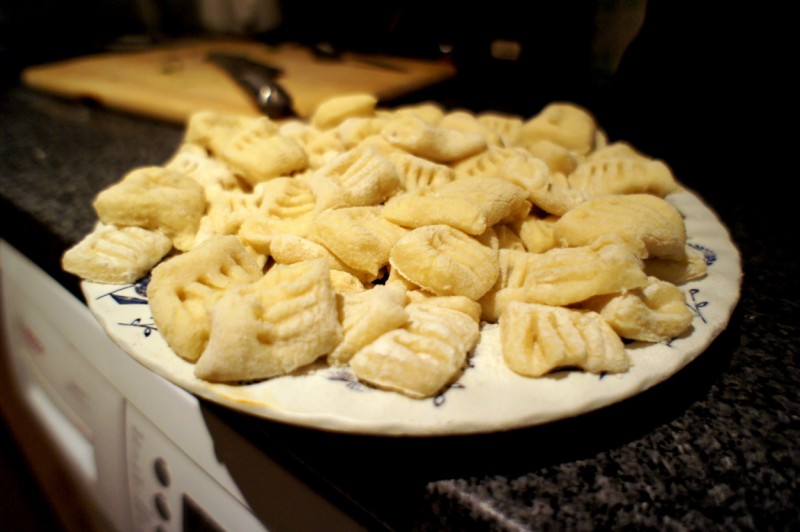
The sauce, quantities guessed turned out pretty damn well too. My version was a bit chunkier but the flavour was just as I remembered. Not very pretty though.

Gnocchi in Walnut Sauce

Serves 4

750gr potatoes - I used Vivaldi
150gr flour
1 egg yolk
1 tsp salt

Boil the potatoes in their skins until tender. Peel (hold the potato with a cloth) and push through a ricer. Beat the egg yolk and add to the potato. Sift the flour and add in thirds, incorporating the flour with the potato as you go. Finally add the salt, combine well and knead lightly. It should be soft and slightly sticky.

Dust your work surface well and roll into a thin sausage. Cut into 1" pieces and press lightly into them with a fork. Place on a well floured plate and refridgerate.

1 tbsp olive oil
3 cloves of garlic, minced
70gr walnuts
A handful of basil, sliced finely
2 handfuls of panko breadcrumbs
2 handfuls of parmesan, grated
1 pint milk

Heat the olive oil and fry the garlic very gently. Meanwhile, toast the walnuts and chop well. Add this to the garlic and toss well. Add the milk and bring to a gentle simmer. Simmer for 10 to 15 minutes. Add the panko breadcrumbs and stir well. Cook for another 5 minutes, then add the parmesan and the basil. Take off the heat. If it's too thick, add a little more milk.

Put on a pan of water to boil. When it's boiling, turn down to a simmer and add the gnocchi. When they're floating they're done. Gently incorporate the sauce into the gnocchi and serve with plenty of black pepper.

Sunday, 16 May 2010

Burts Chip Factory

As part of our trip to Devon which encompassed Riverford Organic Farm and Barbers 1833 cheesemakers in Somerset, we visited Burts Chip Factory. Now, anyone who knows me also knows that I am a crisp fiend. I considered starting up Salty Snacks Anonymous for some therapy. I once went through a phase of eating a packet of ready salted Hula Hoops every day for three months. In an effort to save some cash I bought a multipack and it was a bad move; I ate 3 packets that day.

It was with some excitement that we entered the factory. Bedecked in full splendour of lab coats, shoe coverers and hairnets, we were shown enormous cartons of potatoes. Throughout the year, Burts use different varieties of potato depending on what's best for the season. I rather liked this idea; a spring-time packet is likely to be a little different to that of one bought in, say, the autumn.

A huge, intimidating vat of bubbling sunflower oil was being stirred carefully to help the crisps cook more evenly. Used oil doesn't just get chucked out - it goes to making dog food. The oil keeps their coats shiny. It's all about recycling here; potato slurry goes to local farmers to feed their cows, and any sub-standard crisps are fed to pigs. I would be a happy pig.

Plucking a hot, freshly fried crisp off the production line was a joy. I had to stop myself from greedily shovelling handfuls into my mouth. Unsalted at this stage, they were pure potato goodness.

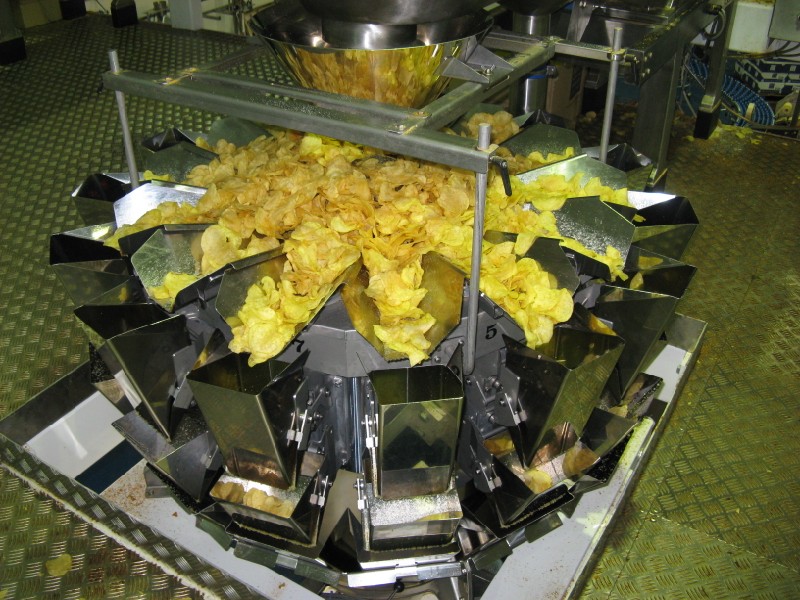
The above nifty contraption sorts the crisps, when seasoned, into perfect bag amounts.

I was surprised by how much work goes into making a bag of crisps. The crucial stage is the frying and the oil has to be kept at a constant temperature for even cooking. Ultraviolet technology checks the crisps in case they get stuck together, resulting in a raw starchy middle, and my favourite part was a weight sensor that blew out a blast of air to reject any packets that were too heavy or too light. It was an eye-opening experience to say the least.

We ended the tour by going to the offices for a crisp tasting session. Soon to launch, Burts will be making a Thai sweet chilli flavour, and we were to try three different types, with the favourite flavour to go on the market. We thought long and hard, we munched many crisps and a favourite emerged, the spiciest of the lot.

My crisp addiciton has been reignited.

Tuesday, 18 November 2008

Hawksmoor

The past couple of weeks have been rather meaty. Only last week, I had a pre-gig dinner in Haché, recommended to me by fellow food bloggers and told that they do very good burgers indeed. They weren't wrong; I had a great medium rare burger topped with Stilton, possibly the best burger I've had so far.

Cut to less than a week later, and I'm told that Hawksmoor do the best steaks in London. If you'd told me a year ago that I would be meeting people from the internet for dinner, I'd have probably laughed at you. But it's not that weird really. Having joined Twitter, myself and a few other bloggers decided that a steak night must be arranged, mainly out of sympathy for someone having to endure a meal at a vegan restaurant that don't cook their food much. So myself, Chris, Helen and Charles (who works at Tipped) met on a rainy Monday night for a healthy dose of protein.

Upon arrival, the name of the restaurant is rather obscure. Luckily I printed out a map before I left, as I have absolutely no sense of direction and frequently get lost. The restaurant is quite simply decorated; a few circular tables, several square and a small bar lined at the back. I'm told the cocktails are great, but as it was a Monday night I resisted. They did serve a mean Punk IPA which I later discovered to be a very good accompaniment to the steak.

The menu is quite extensive. There were starters of ribs, smoked salmon and the like, but we were only there for one thing - the steak. I opted for the 400g rib eye, cooked to medium rare, with a side of triple cooked chips.

All the meat at Hawksmoor is supplied by The Ginger Pig, a rather well known and respected producer. Their beef is Longhorn cattle, raised in North Yorkshire, hung for at least 28 days and cooked simply on a charcoal grill.

Everyone elses steaks came out first, and they were huge. At around 3" thick, they were nicely charred on the outside, and by all accounts, perfectly cooked. When mine came out I was mildly disappointed as it was a mere inch thick but bigger in surface area. However, upon tasting it all disappointment was expelled. It had a great charcoal flavour, whilst still remaining perfectly medium rare, as requested. It was also generously seasonsed, something many restaurants inexplicably fail to do. Served alongside were Béarnaise and peppercorn sauces, my favourite being the peppercorn. Purists will say that steak doesn't need a sauce, but whatever; it was good. Pleasingly, mid-way through I encountered a gorgeous pocket of buttery flavoursome fat, my main reason for ordering the rib eye. The chips were crispy on the outside and fluffy within, and complemented well by a fresh ketchup.

When we got there we were only one of two tables, but when we left it was almost full which is impressive for a Monday night. It isn't cheap, but good meat rarely is. I'm not sure if I can order another steak (or indeed, cook one myself) again as I don't think it would live up to this one.

Hawksmoor
157 Commercial Street
London
E1 6BJ
Tel: 0207 247 7392


Hawksmoor on Urbanspoon

Thursday, 14 August 2008

Tempted?

When I saw a recipe recently for Janssen's Temptation, I was very tempted indeed. Potatoes, cream and anchovies; it instantly appealed.

Although I lived with a Swedish friend for a year, I don't know anything about Scandinavian food. She wasn't much of a cook. Tubes of cod roe resided in the fridge and she had a penchant for Ryvita and ate mostly plain food, and this was my impression of it. I was keen to try this recipe out to see if there was any truth in this.

In Sweden, pickled sprats are used and the Swedish name for it is 'ansjovis'. Apparently these are available in Ikea, but as I haven't got one near, anchovies sufficed. I used the ones in oil, not fresh. This is a great dish to introduce those who are not so keen on anchovies, as they just melt into the dish and lend a deeply savoury quality to it.

It's not a very summery dish, but let's face it. Where's summer? The rain has been catching me unaware all week; I actually left the house with a short skirt and some nice cotton pumps on yesterday. Curses upon the rain.

Janssen's Temptation

Serves 2 as a main, 4 as a side

A few large potatoes (I used King Edwards), sliced to about the thickness of a pound coin. I can't give exact measurements, but enough to fit your casserole dish

4 anchovies per layer of potato

1 white onion, sliced

2/3rds double cream, 1/3rd milk to cover

Breadcrumbs

Softened butter, to dot over the top

Preheat the oven to 220 degrees C. Arrange the potato slices in a fish scale pattern. Scatter the onions over the layer and lay over the anchovies. Season with salt and pepper (don't use salt if you're using anchovies preserved in salt). Repeat until the dish is about 1" from the top. Mix te milk with the double cream to loosen, and pour over the potatoes until they just cover. Scatter over the breadcrumbs and dot with the butter. Bake for 45 mins - 1hr, until the potatoes are cooked through.

As I understand it, this is often served warm as part of a smorgasbord, but I like to eat gratin dishes as a big plateful, with a hefty green salad and a mustardy dressing on the side. It was gorgeous; velvety potato contrasted with the crunchy breadcrumbs was very pleasing indeed.

Tuesday, 1 July 2008

Fishcakes - A Leftover Treat

Mashed potato is one of the greatest comfort foods. I wonder if it stems from childhood, when all food was mashed for easy eating?

Last Sunday saw me laid up on the couch, full of self-loathing and quite hungover. One of these days I'll get bored of feeling rubbish and I'll pack in the booze... Maybe when I'm old. There was only one thing for it - mashed potatoes needed to be made. Of course I over-estimated my appetite and made far too much, but this wasn't a problem. Fishcakes can be a very cheap meal, depending on what fish you want to use. I never bother using fresh fish as I think it's a bit of a waste, but instead I used tinned salmon, tuna or smoked mackerel.

Spicy Fishcakes

Makes 4 large fishcakes

About 300gr mashed potato - this should be quite dry. If you're making this without leftover mash, steam or microwave the potatoes to get the driest mash possible.

1 tin of tuna, drained

2 spring onions, chopped finely

1 big red chilli, chopped finely

1" of ginger, grated

3 tbsp sweetcorn

1 tbsp capers, chopped roughly

A small handful of parsley, chopped finely

1 egg, beaten

Breadcrumbs & flour to coat the cakes

In a big bowl, combine the fish, potatoes, and the rest of the ingredients except the egg, breadcrumbs and flour. Mix thoroughly, and season with salt and pepper. Shape into compact patties. Put the beaten egg on a plate, with the breadcrumbs and the flour on seperate plates. Carefully dip the patties in egg, then flour, then egg, then in breadcrumbs. It's a messy business and you need quite a lot of breadcrumbs; I toasted two slices of stale bread and blended it finely.

Chill for 20 mins and then fry on all sides until browned. Then put the fishcakes in a preheated oven at 170 degrees, and bake for 10 - 15 minutes. Serve with a large wedge of lime (I also like ketchup...) and green beans or salad.

Wednesday, 25 June 2008

Tofu Tuesday on a Wednesday - Braised Pork & Potato with Red Fermented Beancurd

Ok, so it's Wednesday. I got home late on Tuesday night and started making this, but then got hungry waiting for it to cook I had to scoff some Mi Goreng noodles. Thankfully this is the kind of recipe that benefits from the flavours sitting overnight to amalgamate. I was also able to use my new claypot that I bought for £3. Claypots need to be soaked for 24 hours before their first use, and then whatever you cook needs to be in the oven, gradually building heat otherwise it'll shatter. It was a bit nerve-racking, especially when you're hungry.

I won't lie to you; red fermented tofu bloody stinks. I opened the jar and had a tentative sniff and I almost decided not to go through with this recipe. When frying it, it transformed. It's similar to the kind of stink you get from frying shrimp paste - ultimately you know something delicious will come of it.
This is not my recipe, but that of Sunflower's. I've adapted it to fit in my pot and my belly.

Braised Pork & Potato with Red Fermented Beancurd

Serves 2, or 1 generously

250gr belly pork, in chunks
1 tbsp dark soy sauce
Splash of light soy sauce
Pinch of ground pepper

3 fist-sized potatoes, cut into chunks
60mls vegetable oil

1 Asian shallot, chopped finely
2 cloves of garlic, minced
3 slices of ginger
1 square of red beancurd
1 tsp five spice
Splash of Shaoxing cooking wine
1 tsp sugar
1 stalk of spring onion, chopped (optional)

Mix the belly pork with the soy sauces and pepper. Leave to marinate while you prepare everything else. Heat up the oil in a wok until almost smoking. Carefully add the potatoes and fry until browned on all sides - this will take about 10 minutes. Put the potatoes to one side. Pour off the oil, leaving 1 tbsp left. Fry the garlic, shallot and ginger until fragrant. Open the windows, add the beancurd and mash the cube up. Add the pork, leaving the marinade in the bowl, and fry until browned (once again, this will take about 10 mins). Add the wine, the 5 spice and any excess marinade. Bring to the boil, then place the wok contents in the claypot or any other suitable oven proof pot. Add the potatoes in, and then enough boiling water to cover at least the meat. Put the lid on, and stew for 1.5 hours. Here I put it in a cold oven and turned it on to 170 degrees.

The pork becomes meltingly tender. The potatoes hold their shape due to the initial frying, but they also soak up all the flavours of the stew. They're very strong flavours, and less is more with this dish. I think I might prefer it with white rice rather than potatoes - but then I'd always prefer rice.